apan’s SSW Visa in 2026: The No-Degree Route — and Which Sectors Are Still Open
Japan SSW Visa needs foreign workers badly — but in 2026, getting in through its main blue-collar visa depends heavily on which sector you pick and when you apply. The Specified Skilled Worker (SSW) visa is one of the few realistic, government-regulated ways to work in Japan without a university degree. It is also running on strict per-sector caps, and one of the most popular sectors just closed to new overseas applicants. Here is the honest, up-to-date picture.
Quick answer: The Specified Skilled Worker (SSW / Tokutei Ginou) visa lets foreign workers fill jobs in Japan’s labour-shortage sectors without a degree. In 2026 it covers around 16 designated sectors, needs a skills test plus JLPT N4-level Japanese, and comes in two tiers. But intake is capped per sector — new overseas food-service applications have been suspended since 13 April 2026, while construction, care and agriculture stay open.
⚠️ YMYL / disclaimer: This is general information, not legal or immigration advice. Sector availability, caps and rules change frequently. Always confirm the current status of your target sector on Japan’s Immigration Services Agency (ISA) support site before paying for exams, agents, or relocation.
What is the SSW visa, in one minute
Japan launched the Specified Skilled Worker programme in April 2019 to fill severe labour shortages in blue-collar industries. Its two defining features make it stand out from most work visas: no university degree is required, and it is a genuine employment route rather than a “training” scheme like the old Technical Intern Training Program (TITP). Instead of a degree, you prove you can do the job (a sector skills test) and communicate (a Japanese-language test).
SSW Type 1 vs Type 2 — the difference that matters
The visa has two tiers, and understanding them upfront saves heartbreak later:
- SSW Type 1: the entry level. Valid for a cumulative maximum of five years, with no option to bring family, and you must be supported by a registered support organisation. This five-year limit is a lifetime cap on Type 1 status, not a per-employer limit — split across jobs, it still runs out.
- SSW Type 2: the advanced tier. It can be renewed indefinitely, allows you to bring family, and opens a realistic pathway toward long-term or permanent residency. It requires passing a higher-grade skills exam and has expanded to nearly all sectors except care work, which has its own dedicated status.
The sectors — and the crucial “open vs closed” reality
As of 2026 the programme covers roughly 16 designated sectors, spanning care work, food service, construction, agriculture, manufacturing, accommodation, and more. (The exact count varies by how the government groups fields; recent additions like automobile transportation and railway roles push some official tallies higher, so always check the current list.)
Here is the part generic guides skip: the sectors are individually capped, and not all are accepting new overseas workers right now.
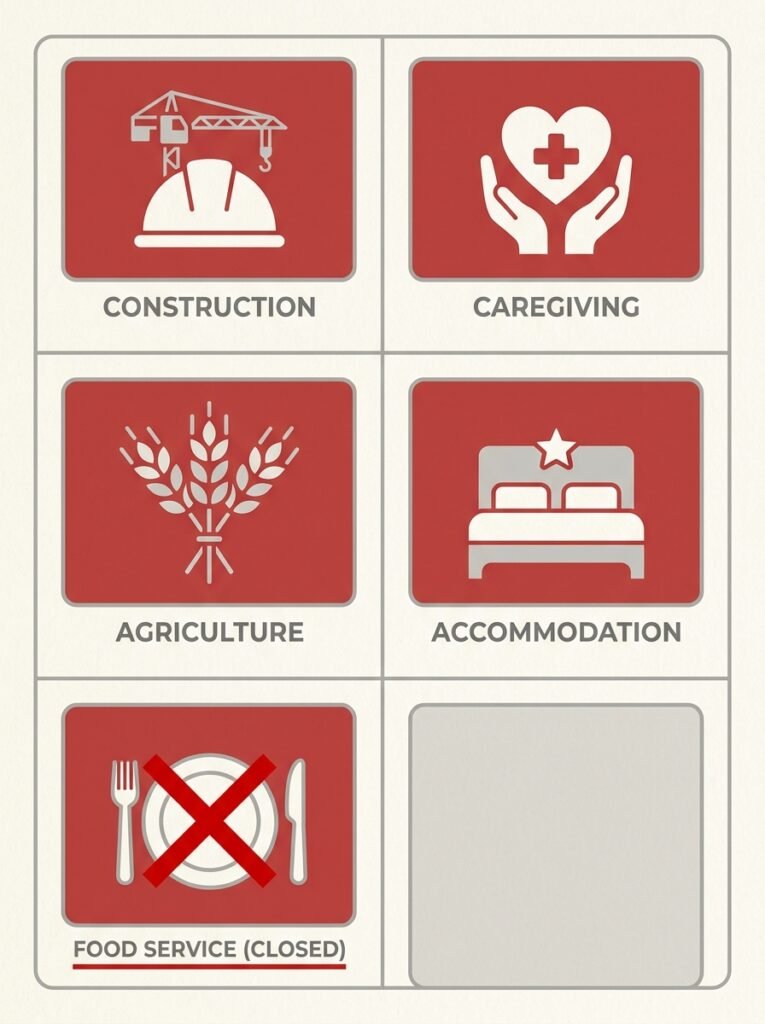
- Food service is closed to new overseas intake. From 13 April 2026, Japan suspended new overseas Certificates of Eligibility for SSW Type 1 food-service roles, because the sector’s 50,000-worker cap for the FY2024–2028 period was expected to be hit by May 2026. Barring an emergency quota increase, no new overseas food-service approvals are expected until the fiscal year resets in April 2027.
- Sectors with substantial room remaining in 2026 include construction, accommodation, care work and agriculture.
The lesson is blunt: caps are real, and timing your application to a sector that is actually open is now a core part of the strategy — not an afterthought.
How big is this really? The numbers behind the push
Japan is not tinkering at the edges. For the FY2024–2028 period, the government set a target of accepting 820,000 SSW Type 1 workers — more than double the programme’s original ceiling. By early 2026, roughly 370,000 SSW holders were already in Japan, about 45% of the way to that goal. In December 2025, officials proposed reshaping the system further — revising the Type 1 cap to around 805,700 and adding a new Employment for Skill Development (ESD/ESDP) status of about 426,200, for a combined intake near 1.23 million through FY2028, with ESD set to replace the old TITP from 2027.
Two things to separate clearly: the food-service suspension is already in effect, while the 805,700 / ESD figures are proposals from late 2025 that may change before they take final form. Treat them accordingly.
Who qualifies for SSW Type 1
The core requirements are consistent across most sectors:
- Be 18 or older and in good health.
- Pass the sector-specific skills evaluation test (most run by Prometric; construction uses the JAC body).
- Pass a Japanese-language test at roughly JLPT N4, or the JFT-Basic (A2) test. Care workers must also pass an additional nursing-care Japanese test.
- Have no serious immigration or criminal record in Japan.
- Note a small cost detail: a Certificate of Eligibility application carries a modest government fee introduced in mid-2025.
Workers who satisfactorily completed the old Technical Intern Training (ii) can often transition to SSW Type 1 without re-sitting the skills and language tests — a valuable shortcut for those already in that pipeline.
The honest picture for Pakistani and South Asian workers
This is where you deserve straight talk. The SSW skills and language exams are held in Japan and across a set of partner countries — commonly including India, Nepal, Bangladesh, Sri Lanka, the Philippines, Vietnam, Indonesia and others. Pakistan is not currently among the standard SSW test-centre countries. The largest SSW populations come from Vietnam, Indonesia, the Philippines and Myanmar.
What that means in practice for a Pakistani applicant:
- You may need to sit the required tests in a country that hosts them, which adds cost and logistics.
- The Japanese-language barrier is real — N4 is not trivial and takes months of genuine study.
- There is no shortcut around the tests for most people; be very wary of anyone claiming otherwise.
None of this makes it impossible, but it does make Japan a harder, longer route for Pakistanis than, say, the Gulf or Korea’s EPS — and you should plan with that reality in mind.
Who this does NOT work for
- You need to bring family immediately. Type 1 does not allow dependants; only Type 2 does.
- You can’t invest in learning Japanese. Without N4-level language, you will not pass.
- You’re set on food service and want to apply from overseas now. That door is shut until at least April 2027.
- You want a fast, degree-free desk job. SSW is built for hands-on shortage sectors, not office roles.
- You expect to skip the skills or language exams. Outside the TITP-transition route, there is no legitimate bypass.
Avoiding SSW visa scams
No-degree routes attract fraud, so protect yourself:
- Confirm your sector is actually open on the Immigration Services Agency support site before paying anyone.
- No agent can guarantee a Japanese visa, a job, or an exam pass. Guarantees are a red flag.
- Never pay for a “guaranteed” placement or a job offer that skips the skills and language tests.
- Use registered support organisations and legitimate, licensed recruiters, and verify test bookings through official Prometric or sector-body channels.
- Watch for fake “cap increase” or “Pakistan test-centre now open” claims — verify any such news on official Japanese government sources first.
Key Takeaways
- The SSW visa is a no-degree, government-regulated route into Japan’s labour-shortage sectors, with a skills test and JLPT N4-level Japanese required.
- Type 1 caps you at five years with no family; Type 2 is renewable, allows family, and leads toward long-term residency.
- Food-service overseas intake is suspended from 13 April 2026; construction, care and agriculture remain open — check sector status before applying.
- Japan’s targets are huge (820,000 for FY2024–2028; larger proposals for later), but caps are enforced per sector.
- For Pakistani applicants, the test-centre and language hurdles are real — plan for a longer, harder route and avoid anyone promising shortcuts.
FAQ
1. Do I need a degree for Japan’s SSW visa? No. The Specified Skilled Worker visa was specifically designed as a no-degree route. Instead of a degree, you must pass a sector-specific skills evaluation test and a Japanese-language test at roughly JLPT N4 level.
2. Which SSW sectors are open in 2026? Most of the roughly 16 designated sectors remain open, including construction, care work, accommodation and agriculture. However, new overseas food-service applications have been suspended since 13 April 2026 after that sector’s cap filled. Always confirm current sector status with Japan’s Immigration Services Agency.
3. What is the difference between SSW Type 1 and Type 2? Type 1 allows a cumulative five years, no family, and needs a support organisation. Type 2 can be renewed indefinitely, allows family, and offers a pathway toward permanent residency, but requires a higher-level skills exam.