
Germany’s Opportunity Card 2026: Move Without a Job Offer — Here’s Who Qualifies
Imagine landing in Germany with no job offer in hand — and being fully allowed to stay, job-hunt, and even work part-time while you do it. That’s exactly what the Germany Opportunity Card 2026 (Chancenkarte) is built for. For skilled workers across Pakistan and South Asia who keep hitting the “you need a German job first” wall, this is one of the most realistic legal routes into Europe’s biggest economy.
But it’s widely misunderstood. It is not a work visa, it is not a guaranteed job, and it is not the same as the EU Blue Card. Get those distinctions right and you’ll apply to the correct thing the first time. Here’s the honest, up-to-date breakdown.
What is the Germany Opportunity Card 2026? The Opportunity Card (Chancenkarte) is a points-based residence permit that lets skilled non-EU workers — including Pakistanis — move to Germany for up to 12 months to look for a qualified job, without a prior offer. You qualify either as a recognized skilled worker or by scoring at least 6 points, plus proof of funds and basic language.
What the Opportunity Card actually is
The Chancenkarte was introduced on 1 June 2024 under Section 20a of Germany’s Residence Act, created specifically for non-EU nationals who want to come and search for skilled employment before landing a contract. It’s issued for up to 12 months, and it exists because Germany has a serious shortage of skilled workers in fields like IT, engineering, healthcare, and skilled trades.
The key difference from other routes: the EU Blue Card needs a qualifying job offer already in hand, while the Opportunity Card needs no offer — it’s a permit to come and look. Think of it as a legal, time-limited “job search” residence, with the right to work part-time while you search.
Two ways to qualify
There are two separate routes, and you only need one of them:
Route 1 — Recognized skilled worker (no points needed). If your university degree or vocational qualification is fully recognized in Germany — checked through the official Anabin database, and rated equivalent — you qualify as a skilled worker and do not need to score any points. You still have to meet the language and financial requirements.
Route 2 — Points system (need at least 6 points). If your qualification is recognized in your home country but not yet fully recognized in Germany, you can still qualify by scoring a minimum of six points on the Chancenkarte points grid, provided you meet the baseline requirements first.
Checking your degree on Anabin early is the single most important step — if your qualification doesn’t have the right Anabin rating, the skilled-worker route simply won’t work, and you’ll need the points path instead.
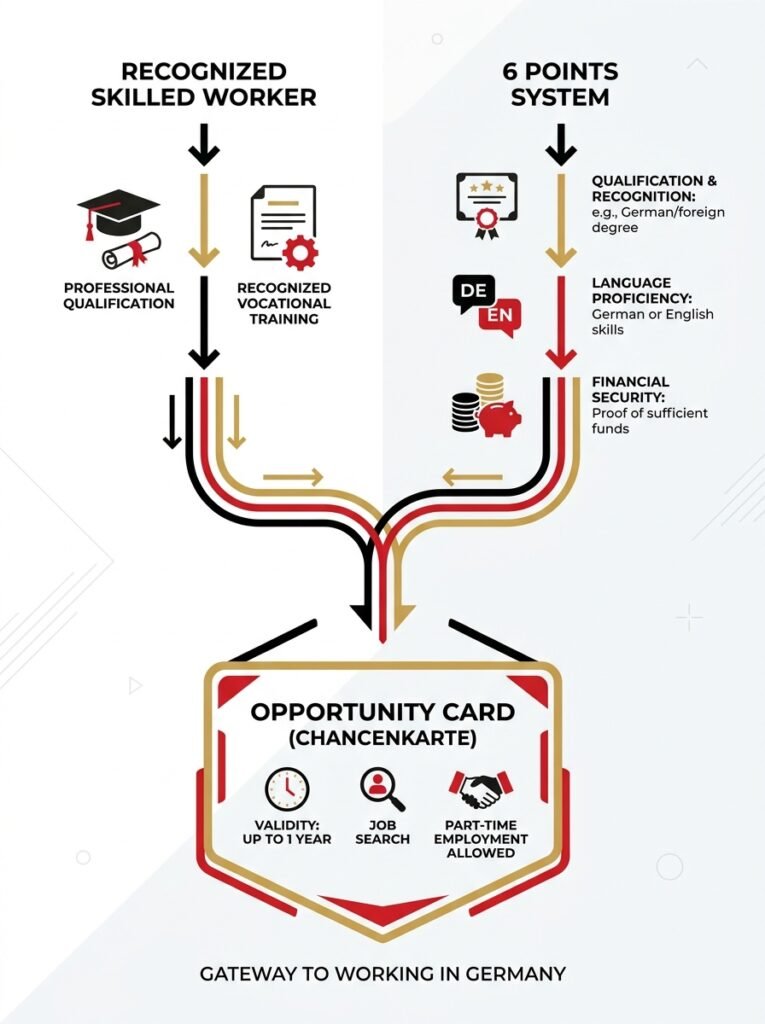
The Chancenkarte points system, explained
To use the points route in 2026, you first meet these baseline requirements:
- Qualification: a university degree or at least two years of vocational training, recognized in your home country.
- Language: German at A1 level or English at B2 level (for English, that’s roughly IELTS 5.5–6.5).
- Funds: proof you can support yourself (covered below).
Then you collect at least 6 points from factors such as:
- Partial recognition of your foreign qualification in Germany.
- Work experience — several years of relevant experience within the last few years scores more; a shorter track record scores less.
- Language skills — stronger German (or good German plus English) earns points.
- Age — being younger (typically under 35) earns points.
- Ties to Germany and previous legal stays in Germany.
- Your spouse/partner also qualifying can add points.
Because the exact point values differ between unofficial guides, don’t rely on a random table you found online. Use the official Make-it-in-Germany Opportunity Card points checker to calculate your real score before you apply.
2026 financial requirement
You must prove you can fund yourself during the search. For 2026, the figure reported across sources is at least €1,091 per month — about €13,092 for the year — most commonly shown via a blocked account (Sperrkonto), though a part-time work contract or a formal sponsor declaration can also be accepted. Confirm the current amount and accepted proof with the German mission handling your application, since these figures are updated periodically.
What you’re allowed to do on the card
The Opportunity Card is genuinely flexible while you job-hunt:
- Part-time work up to 20 hours per week, in any sector, to support yourself.
- Trial employment (Probebeschäftigung) of up to two weeks per employer, with no cap on how many trials you do — a low-risk way for employers to test you and for you to convert a trial into an offer.
- Germany’s 2026 minimum wage is €13.90 per hour, which applies from day one of any part-time or trial work.
How to apply for the Germany Opportunity Card 2026
- Check your qualification on Anabin. Decide whether you’re on the recognized-skilled-worker route or the points route.
- Confirm your points (if needed). Use the official points checker to make sure you clear six.
- Sort your language proof. Get your German A1 or English B2 certificate ready.
- Open a blocked account (or arrange the accepted proof of funds) for the required amount.
- Gather your documents (checklist below) and book an appointment at the German embassy/consulate or via the official visa portal for your country.
- Submit your application and pay the visa fee. Processing times vary by mission, so apply early.
- Travel to Germany and register your address (Anmeldung) within two weeks of arrival.
- Start your job search — apply widely, use trial employment, and network.
- Convert once you have a qualifying offer: book an appointment at the local Ausländerbehörde to switch to a work permit or EU Blue Card. Conversion fees generally run €56–€100 depending on the federal state.
Documents you’ll typically need
- Valid passport
- Completed application form and biometric photos
- Degree/vocational certificates and transcripts (plus Anabin/recognition evidence)
- Proof of language proficiency (German A1 or English B2)
- Proof of funds (blocked account statement or accepted alternative)
- CV and, where asked, a short cover/motivation letter
- Health insurance valid for Germany
- Proof of accommodation where required
Requirements differ slightly by mission, so always cross-check the exact list on your German embassy/consulate page before booking.
After you find a job
Once you secure a qualifying role, you convert the Opportunity Card into a longer-term status. If your salary meets the 2026 EU Blue Card thresholds — €50,700 gross per year for standard occupations, or €45,934.20 for shortage occupations, recent graduates, and qualifying IT specialists — the Blue Card is often the best path, with a faster route to permanent residence. If you have an offer but can’t convert immediately (for example, recognition is still pending), a follow-up Opportunity Card (Folge-Chancenkarte) can be granted for up to two more years, subject to approval.
Who the Opportunity Card is not for
Being honest here saves you money and heartbreak:
- You don’t have a recognized degree or two years of vocational training. Without a qualifying credential, neither route works yet.
- You can’t meet the language bar (German A1 or English B2) — sort this first.
- You can’t show the required funds. The blocked account is a hard requirement, not a suggestion.
- You expect a guaranteed job. The card gives you permission to search, not a job. Germany is competitive, and recognition of foreign qualifications can be slow.
- You want to bring family immediately with no income. Family reunification on the search phase is limited; it’s far easier once you’re in stable employment.
If that’s you, treat this cycle as preparation — fix the missing piece and apply from a position of strength.
Avoid scams and fake agents
High demand attracts exploitation. Protect yourself and your money:
- Use official sources only: Make-it-in-Germany, the Federal Office for Migration and Refugees (BAMF), and your German embassy/consulate. Verify every figure and rule there.
- No one can “guarantee” an Opportunity Card or a German job. Anyone promising guaranteed approval for a fee is running a scam.
- You apply through the official German mission — not through a middleman who “has contacts.”
- Never pay for a fake job offer or a forged qualification. It will get your application refused and can carry a ban.
- Legitimate help exists (recognition advisors, licensed relocation firms), but you should always be able to verify the process yourself on official portals.
Realistic expectations
The Opportunity Card is a real, powerful route — but it rewards preparation. Strong candidates line up their Anabin recognition, language certificate, funds, and a sharp CV before they fly, then hit the job market hard from day one. Those who arrive unprepared can burn months and money. Go in clear-eyed and it can genuinely change your trajectory.
Key Takeaways
- The Germany Opportunity Card 2026 lets skilled non-EU workers, including Pakistanis, move to Germany for up to 12 months to find a job — no offer required.
- Qualify either as a recognized skilled worker (via Anabin) or by scoring at least 6 points, plus language (German A1 / English B2) and funds.
- Show around €1,091/month (~€13,092/year), usually via a blocked account.
- You can work part-time (20 h/week) and do 2-week trial jobs while searching.
- It’s not a job guarantee — verify everything on Make-it-in-Germany / BAMF and avoid “guaranteed approval” scams.
FAQ
Q1: What is the Germany Opportunity Card? It’s a points-based residence permit (the Chancenkarte, under Section 20a of Germany’s Residence Act) that lets skilled non-EU nationals move to Germany for up to 12 months to search for a qualified job without already having an offer, with the right to work part-time while they look.
Q2: Who is eligible for the Opportunity Card in 2026? Skilled non-EU workers who either hold a qualification fully recognized in Germany (recognized-skilled-worker route, no points needed) or who score at least 6 points on the Chancenkarte grid. All applicants must also meet the language requirement (German A1 or English B2) and prove sufficient funds.
Q3: How many points do you need for the Chancenkarte? At least six points, earned from factors such as qualification recognition, work experience, language skills, age, and ties to Germany. Exact values are best confirmed with the official Make-it-in-Germany points checker, since unofficial tables vary.