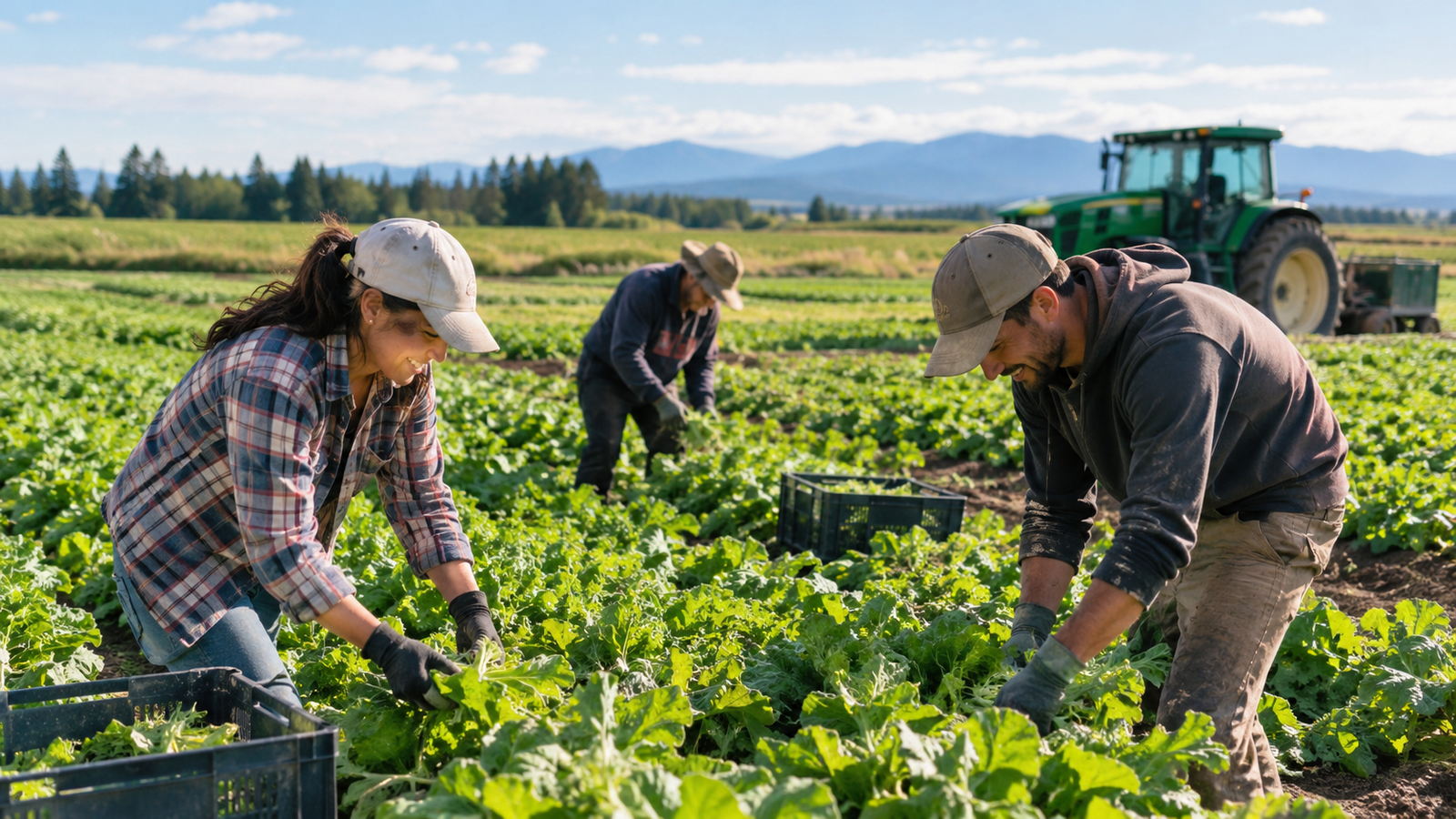
Canada’s agricultural industry offers employment opportunities for people with different backgrounds, including experienced farm employees and newcomers looking for international work. From crop harvesting to greenhouse maintenance and livestock care, agricultural businesses need workers to keep their operations running throughout the year.
For international candidates, Canada Farm Worker Jobs With Visa Sponsorship 2026 – Hiring Guide explains how to identify suitable employers, understand recruitment arrangements, prepare an application and pursue the correct Canadian work authorization.
The opportunity is not limited to one nationality. People from Asia, Africa, Europe, Latin America and other regions can investigate eligible agricultural recruitment routes. However, each applicant must meet the requirements of the particular job and immigration program.
The most important point is understanding that an employer’s willingness to recruit internationally is not the same as receiving immigration approval.
Featured snippet: What are Canadian farm jobs with visa sponsorship?
Canadian farm jobs with visa sponsorship are agricultural positions offered by employers who may support eligible foreign workers through an approved immigration route. Where an LMIA is required, the employer must obtain the appropriate assessment before the worker applies for an employer-specific work permit.
Understanding Canada Farm Worker Jobs With Visa Sponsorship 2026 – Hiring Guide
Agricultural employment in Canada covers a much wider range of activities than picking fruit or collecting vegetables.
Modern farms operate with different production systems. Some grow crops in open fields, others maintain controlled greenhouse environments, while livestock businesses require regular animal care and facility maintenance.
These operations can recruit people for both seasonal and longer-term positions.
For an international applicant, the first challenge is identifying which jobs are genuinely open to overseas recruitment.
A vacancy might be advertised publicly but intended for people who already have permission to work in Canada. Another employer may be prepared to consider foreign candidates and complete the required immigration procedures.
These are two different situations.
What does employer sponsorship actually mean?
The expression sponsorship is widely used in international employment searches. In Canada, however, agricultural recruitment often involves the Temporary Foreign Worker Program and an employer-specific work permit.
The employer may need to demonstrate that suitable Canadian citizens or permanent residents are not available for the position.
Where required, this involves obtaining a Labour Market Impact Assessment, commonly called an LMIA.
After the employer completes the necessary process, the selected worker can use the relevant employment and immigration documents to submit a work-permit application.
The process involves separate decisions by the employer and immigration authorities. Neither an interview nor a written job offer guarantees approval.
The three main stages applicants should understand
- Employment selection: A genuine Canadian farm business considers the applicant and offers suitable employment.
- Employer authorization: The business completes the applicable LMIA or other employer-side requirements.
- Worker authorization: The applicant submits the required immigration application and receives a decision.
Understanding these stages helps candidates avoid paying money to recruiters who promise employment or visas without explaining the actual process.
Also Read: Canada Dishwasher Jobs With Visa Sponsorship 2026
Which Canadian agricultural employment programs are available?
Not every foreign worker enters Canada through the same agricultural recruitment arrangement.
The program depends on the worker’s nationality, the employer’s eligibility, the type of agricultural production and the nature of the job.
Two particularly important routes are the Agricultural Stream and the Seasonal Agricultural Worker Program.
| Feature | Agricultural Stream | Seasonal Agricultural Worker Program |
|---|---|---|
| Recruitment area | Any country | Participating countries |
| Employment nature | Eligible agricultural employment | Seasonal agricultural employment |
| Employer requirements | Applicable agricultural LMIA conditions | SAWP-specific conditions |
| Recruitment arrangements | Employer-led | Established government recruitment arrangements |
| Work authorization | Appropriate work permit | Appropriate work permit |
| Suitable applicants | Eligible international workers | Citizens of participating countries |
Canada+2
Agricultural Stream: Opportunities for applicants worldwide
The Agricultural Stream is an important option for international candidates because employers can recruit eligible workers from any country.
This does not mean every agricultural position qualifies.
The employer’s production must fall within an eligible commodity category, and the work must meet the applicable primary agricultural requirements.
Examples of eligible production areas include:
- Fruit and vegetable farming.
- Dairy and cattle production.
- Poultry and duck farming.
- Sheep and pig farming.
- Greenhouse and nursery operations.
- Mushroom cultivation.
- Grain and oilseed production.
- Horse and other qualifying livestock operations.
The actual duties must fit the program’s requirements. A job in a food-processing factory, for example, should not automatically be treated as an Agricultural Stream position simply because the business handles farm products.
The official program overview provides the relevant commodity and activity conditions. Canada+1
Seasonal Agricultural Worker Program
SAWP is designed around recruitment arrangements between Canada and participating countries.
It includes Mexico and participating Caribbean countries. Workers generally need to be recruited through the appropriate government arrangements in their home country.
This distinction matters because applicants cannot assume that they can join SAWP simply by finding an employer advertising a farm vacancy.
People whose countries do not participate should investigate other eligible recruitment routes instead. Canada+1
What types of Canadian farm jobs can international applicants find?
Agricultural employers need different skills depending on their operations.
Some positions involve repetitive manual work, while others require practical knowledge of animals, growing systems or machinery.
The following table introduces common occupational categories.
| Job category | Main responsibilities | Helpful background |
|---|---|---|
| Harvesting worker | Collecting and sorting crops | Physical work |
| Fruit picker | Gathering ripe fruit | Outdoor experience |
| Vegetable farm worker | Planting and maintaining crops | Gardening or farming |
| Greenhouse assistant | Plant care and production support | Horticulture |
| Dairy farm assistant | Feeding and caring for cattle | Animal handling |
| Poultry worker | Maintaining poultry facilities | Livestock knowledge |
| General livestock worker | Feeding and monitoring animals | Farm experience |
| Machinery operator | Using agricultural equipment | Relevant machinery skills |
| Nursery worker | Growing and maintaining plants | Gardening or nursery work |
Fruit picking jobs Canada
Fruit harvesting requires workers who can handle crops carefully and maintain an efficient picking routine.
Depending on the farm, employees may collect apples, berries, grapes and other produce.
The work can involve standing for extended periods, carrying containers, working outdoors and sorting harvested products.
Applicants should ask whether compensation is hourly, piece-rate or based on another approved arrangement. The employment agreement should explain how earnings are calculated.
Greenhouse worker jobs Canada
Greenhouse operations provide a different working environment from outdoor farms.
Employees may help prepare growing areas, move seedlings, water plants, remove unwanted growth and organize produce for distribution.
Some businesses operate throughout the year, although the number of available positions can change according to production requirements.
Basic horticultural knowledge can be helpful, but the exact experience needed depends on the employer.
Livestock farm worker jobs
Livestock businesses require regular attention because animals need feeding, monitoring and clean facilities.
Workers may distribute feed, clean pens, assist with routine animal care and report unusual behaviour to supervisors.
Dairy operations may involve milking equipment, while poultry and pig farms have their own daily management routines.
These jobs can involve early starts and weekend duties. Applicants should understand the schedule before accepting employment.
Agricultural machinery and equipment positions
Some farms need employees who can operate tractors, harvesters, loaders and other machinery.
These positions generally demand more practical experience than basic harvesting work.
Candidates should describe their actual equipment knowledge and any relevant training. They should not claim qualifications or operating experience they cannot demonstrate.
How much can farm workers earn in Canada in 2026?
Income is an important consideration for anyone thinking about moving abroad for agricultural employment.
Canadian farm wages are not identical across the country. Compensation depends on the province, type of agricultural production, position, working arrangement and applicable employment rules.
The federal government publishes minimum wage requirements for different agricultural commodities under its foreign-worker program.
For example, the following figures show selected rates for nursery-grown trees, including greenhouse and nursery operations, effective October 1, 2026.
| Province or territory | Hourly wage (CAD) |
|---|---|
| Alberta | $18.34 |
| British Columbia | $18.25 |
| Manitoba | $16.40 |
| New Brunswick | $15.90 |
| Newfoundland and Labrador | $16.35 |
| Nova Scotia | $17.00 |
| Ontario | $17.95 |
| Prince Edward Island | $17.30 |
| Saskatchewan | $15.70 |
| Yukon | $18.51 |
These are selected official agricultural wage requirements for a specific commodity category, not a universal wage schedule for every Canadian farm position. Quebec has separate guidance. Canada
What could these wages mean for a worker’s income?
Consider an illustrative position paying CAD $18.25 per hour.
| Earnings period | Gross amount |
|---|---|
| One hour | CAD $18.25 |
| 40-hour week | CAD $730 |
| Average month | CAD $3,163 |
| 52 working weeks | CAD $37,960 |
This example assumes the same hourly rate and 40 paid hours every week.
Actual earnings can be different. Seasonal workers may not have employment throughout the entire year, and weekly hours can change according to the farm’s production schedule.
Why two farm workers may receive different wages
Several factors explain differences in agricultural compensation.
1. Type of production: Grain, livestock, fruit and greenhouse operations can have different wage requirements.
2. Province: Employment conditions and applicable wage rules differ across Canadian jurisdictions.
3. Experience: A worker with relevant machinery or livestock skills may qualify for a different position from an entry-level labourer.
4. Responsibilities: Supervisory duties and specialist work can affect compensation.
5. Working arrangements: Contract length, working hours and applicable overtime rules influence total earnings.
Applicants should compare the written offer with the official wage requirements for the exact occupation and commodity.
Where can international applicants find LMIA farm jobs Canada?
Finding an employer is often the most challenging part of an overseas agricultural job search.
Instead of depending on random recruitment advertisements, candidates should build their search around identifiable businesses and established employment services.
Canada’s Job Bank is a useful starting point because it includes a dedicated search experience for employers recruiting temporary foreign workers.
A search conducted for this article showed approximately 230 farm-worker results in its temporary foreign worker search. This is a changing search result, not a fixed annual vacancy count. Job Bank
Examples of agricultural vacancies
The following advertisements appeared in the Job Bank search snapshot:
| Advertised position | Location | Listed hourly pay |
|---|---|---|
| Farm worker | Abbotsford, British Columbia | $18.25 |
| Fruit farm worker | Kelowna, British Columbia | $18.63 |
These are examples of published advertisements, not confirmed current vacancies or guarantees that the employers will recruit a particular overseas applicant. Both listings were marked as having an LMIA requested, which is not the same as an approved assessment. Job Bank
Useful websites for searching Canadian agricultural employment
1. Canada Job Bank
Search for agricultural positions and examine advertisements from employers recruiting temporary foreign workers.Explore farm worker vacancies
2. Employment and Social Development Canada
Review the official rules for employers using agricultural recruitment programs.Explore Agricultural Stream
3. WorkBC
Find provincial employment resources and information about opportunities in British Columbia.Visit WorkBC
4. SaskJobs
Explore employment opportunities and recruitment information in Saskatchewan.Visit SaskJobs
Search terms that can improve your results
A broad search for farm jobs may return positions that are not suitable for overseas applicants.
Use specific job descriptions to narrow the results:
- General farm worker.
- Fruit harvesting labourer.
- Greenhouse assistant.
- Dairy farm worker.
- Poultry farm labourer.
- Nursery worker.
- Livestock assistant.
- Agricultural machinery operator.
Read the entire advertisement. Pay attention to its application method, location, experience requirements and whether the employer is prepared to consider foreign workers.
Understanding the LMIA status of a vacancy
The status displayed in a job advertisement deserves particular attention.
| Advertisement status | What it means |
|---|---|
| LMIA requested | An application has been submitted or requested by the employer |
| Positive LMIA | The employer has received a favourable assessment |
| No LMIA information | The advertisement does not establish the employer’s LMIA status |
| LMIA-exempt | A different legal exemption may apply, if the position qualifies |
A candidate should never interpret an LMIA-requested label as proof that a work permit is available.
What qualifications and eligibility conditions should applicants meet?
People from different countries may have different educational and employment backgrounds. Fortunately, agricultural recruitment does not require every applicant to have the same qualifications.
An entry-level harvesting position may have different expectations from a job involving specialized machinery or livestock management.
The employer’s requirements and immigration eligibility must both be considered.
General application requirements
| Area | What to prepare |
|---|---|
| Identity | Valid passport and personal information |
| Employment history | Accurate CV and previous job details |
| Agricultural background | Relevant experience, if required |
| Language ability | Ability to understand workplace instructions |
| Medical requirements | Examination when applicable |
| Immigration documents | Documents required for the relevant work permit |
| Employment conditions | Understanding of the written contract |
A degree is not automatically necessary for every general agricultural labour position.
However, an employer may request previous experience, technical training or relevant practical abilities.
Is farm experience necessary?
Not for every position.
Some employers can train new workers to perform routine tasks. Others prefer candidates who already understand agricultural production.
People who have previously worked in gardening, food production, crop maintenance, animal care or warehouse operations may have useful transferable skills.
Applicants should explain what they have actually done rather than simply listing generic claims such as hardworking or experienced.
For example, a candidate who has helped maintain vegetable crops can describe planting, watering, harvesting and sorting duties.
That provides a more meaningful picture of their abilities.
Do applicants need an English-language test?
There is no universal IELTS requirement for every general agricultural work-permit application.
Nevertheless, communication can matter during recruitment and employment.
A worker may need to understand safety instructions, equipment guidance, daily schedules and directions from supervisors.
Some employers may require a particular level of English or French, depending on the position.
Applicants should check the vacancy rather than assuming that every farm job has identical language conditions.
Can applicants from different countries apply?
Yes, eligible people from many countries can investigate Canadian agricultural employment.
The Agricultural Stream allows employers to recruit from any country when the applicable requirements are met.
However, country eligibility is not the only consideration. The applicant must also qualify for the position and satisfy Canadian immigration requirements.
SAWP has its own participating-country restrictions and recruitment arrangements. Canada+1
How does the Canadian farm worker work permit process work?
A genuine employment offer is only one part of the process.
International candidates must understand what happens between employer selection and receiving permission to begin working in Canada.
The following stages provide a practical explanation.
Stage 1: Identify a suitable agricultural employer
Start by identifying businesses that operate in eligible agricultural sectors.
Look for employers with clear business information, identifiable locations and properly described vacancies.
Read the responsibilities carefully. A job title alone does not establish whether a position qualifies under a particular immigration program.
Stage 2: Apply and complete the recruitment process
Send a professional CV that matches the position.
If the employer is interested, they may arrange a telephone or video interview to discuss your experience and availability.
Use the interview to understand the job rather than concentrating only on the possibility of obtaining a visa.
Ask about the daily duties, work location, employment duration, wages and accommodation.
Stage 3: Employer completes the required LMIA process
Where an LMIA is necessary, the employer must follow the applicable federal requirements.
These may involve demonstrating the legitimacy of the business, meeting recruitment obligations, providing suitable employment conditions and complying with agricultural program rules.
For the relevant Agricultural Stream recruitment requirements, employers must generally complete the required advertising for at least 14 consecutive calendar days within the three months before submitting the LMIA application. Canada+1
Stage 4: Receive the appropriate employment documents
Once the relevant employer-side approval is obtained, the employer provides the documents needed for the worker’s immigration application.
For an LMIA-required position, these generally include the positive LMIA information and employment offer.
Some positions may qualify for an LMIA exemption, in which case a different employer documentation process applies.
Stage 5: Apply for an employer-specific work permit
Eligible applicants generally apply through the official Canadian immigration application system.
The application may require:
- Passport details.
- Employment offer.
- LMIA documentation, when required.
- Employment history.
- Relevant certificates.
- Biometrics, when applicable.
- Medical examination, when required.
- Additional supporting evidence requested by IRCC.
The exact checklist depends on the applicant’s situation.
Stage 6: Wait for the immigration decision
After applying, monitor the immigration account for updates.
Authorities may request additional documents, medical information or biometrics.
Applicants should respond within the deadlines provided.
A positive LMIA does not replace the work-permit decision. Only after obtaining the necessary authorization can the worker begin employment in Canada. Canada+1
Which documents should applicants prepare before applying?
An organized application makes it easier for an employer to understand a candidate’s background and for immigration authorities to assess the information provided.
The documents required can vary, but preparing the following materials in advance is a sensible approach.
| Document | Why it may be needed |
|---|---|
| Valid passport | Identity and travel information |
| Professional CV | Employment history and practical skills |
| Experience certificates | Evidence of previous work |
| Education certificates | Relevant educational background |
| Employment offer | Details of the Canadian position |
| LMIA information | Evidence of employer authorization where required |
| Police certificates | When requested by immigration authorities |
| Medical records or examination results | When applicable |
| Biometrics | When required for the application |
Preparing a professional agricultural CV
A farm worker CV does not need complicated language or an elaborate design.
It should explain the applicant’s practical abilities clearly.
A useful CV generally includes:
- Full name and contact information.
- Country of residence.
- Previous employment.
- Agricultural or related experience.
- Machinery or equipment skills.
- Relevant training.
- Languages spoken.
- Availability for employment.
Candidates without farm experience can describe relevant work in gardening, cleaning, packing, warehouse operations or animal care.
All information should be accurate. An impressive-looking CV is not useful if the applicant cannot support its claims during an interview.
Why consistent documents matter
Differences between application forms, passports and employment records can create questions during assessment.
Check spelling, dates, employment periods and personal details before submitting documents.
If a document is unavailable, ask the relevant authority or employer what alternative evidence may be accepted instead of creating a replacement that misrepresents the original information.
What should workers know about accommodation, transportation and workplace conditions?
Moving to another country for agricultural employment involves more than accepting an hourly wage.
A worker may be moving to a rural community, living away from family and depending on transport arrangements provided by the employer.
These practical details should be understood before accepting the position.
Accommodation arrangements
Some agricultural employers must arrange suitable accommodation for temporary foreign workers under the applicable program requirements.
Under the Agricultural Stream, employers must meet federal housing standards and provide accommodation that is adequate, suitable and affordable.
For qualifying on-farm housing arrangements, the federal rules generally limit the permitted wage deduction to CAD $30 per week, unless the applicable provincial or territorial standard is lower. Different rules apply to certain off-farm accommodation arrangements. Canada
Before accepting a position, ask:
- What type of accommodation is available?
- How many people share a room?
- Is the property close to the workplace?
- What housing deductions are permitted?
- Are utilities included?
- Can workers choose private accommodation?
Get the terms in writing.
Transportation to and from Canada
Transportation is another important employment condition.
Under the Agricultural Stream requirements, employers must pay the required round-trip transportation costs between the worker’s country of permanent residence and the Canadian workplace.
They cannot recover these costs from the temporary foreign worker.
Where required, employers must also provide transportation between employer-provided accommodation and the workplace without charging the worker. Canada
This is particularly important for candidates considering jobs in remote agricultural communities.
Health protection and workplace safety
Farm work may involve heavy equipment, animals, chemicals and changing weather conditions.
Workers should receive suitable safety instructions and equipment for their duties.
Employers must follow applicable workplace safety requirements and provide the necessary protection.
Where the program requires private emergency medical insurance before provincial or territorial health coverage begins, the employer must arrange and pay for that coverage without recovering its cost from the worker. Canada
Candidates should ask how workplace injuries are reported, what protective equipment is supplied and whom to contact if a safety problem occurs.
How can international applicants avoid fraudulent farm job offers?
Overseas employment searches can attract dishonest intermediaries because applicants may be willing to spend money to secure an opportunity abroad.
A convincing advertisement does not necessarily represent a genuine employer.
The safest approach is to verify the business, understand the recruitment process and avoid financial commitments based on promises.
Common warning signs
| Warning sign | Why it matters |
|---|---|
| Guaranteed visa approval | Immigration decisions are made by authorities |
| Payment for a guaranteed LMIA | Employer recruitment costs must not be recovered from workers |
| No written employment offer | The actual working conditions remain unclear |
| Unverifiable company details | The recruiter may not represent a genuine employer |
| Pressure to pay immediately | Can be used to prevent proper verification |
| Requests for false documents | Can seriously damage an immigration application |
| Unrealistic salary promises | Compensation should be checked against official requirements |
Can an employer or recruiter charge an LMIA recruitment fee?
Workers should understand the difference between legitimate immigration expenses and prohibited recruitment charges.
Under the Agricultural Stream rules, employers must ensure that recruitment fees are not charged to or recovered from temporary foreign workers, whether directly or indirectly.
The same responsibility extends to people recruiting on the employer’s behalf.
This means a recruiter should not demand money from a worker to secure the employer’s recruitment approval or recover recruitment expenses through wage deductions.
Applicants may still have legitimate personal immigration expenses, such as applicable government application fees. These should be clearly distinguished from recruitment charges. Canada
A practical employer-verification process
Before sharing sensitive documents or accepting an offer:
- Search for the business using its actual name.
- Verify its location and contact details independently.
- Check whether the vacancy is published through a recognized recruitment channel.
- Speak directly with the employer or an authorized representative.
- Request a written employment agreement.
- Confirm the wage and accommodation arrangements.
- Ask about the employer’s LMIA status, if applicable.
- Check the federal list of employers found non-compliant.
- Keep copies of communications and payment records.
Do not rely solely on screenshots, social media profiles or messages claiming that a person has access to Canadian immigration officials.
A legitimate recruitment process should allow reasonable time for verification.
Can a Canadian agricultural job lead to permanent residence?
Some international workers hope that a temporary agricultural position will eventually allow them to settle in Canada permanently.
This is understandable, but temporary employment and permanent immigration are separate legal matters.
An employer-specific work permit authorizes employment under its stated conditions. It does not automatically provide permanent-residence status.
A worker may investigate other immigration opportunities later, but eligibility depends on the program available at that time.
Relevant considerations can include:
- Type of occupation.
- Duration and nature of Canadian work experience.
- Language proficiency.
- Educational qualifications.
- Age and other selection criteria.
- Provincial immigration requirements.
- Current federal immigration policies.
Applicants should not accept an employment offer on the assumption that permanent residence will automatically follow.
Anyone planning long-term settlement should assess the relevant immigration programs independently and use official government information.
Key Takeaways
- Canadian agricultural employers recruit temporary foreign workers through different immigration arrangements.
- The Agricultural Stream is open to eligible workers from any country.
- SAWP operates through participating-country recruitment arrangements.
- Not every farm vacancy is available to overseas applicants.
- LMIA approval and work-permit approval are separate decisions.
- Agricultural wages depend on the commodity, province and job responsibilities.
- Job Bank is a useful starting point for finding vacancies.
- Employers must comply with applicable accommodation and transportation obligations.
- Recruitment fees must not be passed on to temporary foreign workers under the Agricultural Stream rules.
- Applicants should verify employers before sharing personal information or making financial commitments.
- A temporary agricultural position does not guarantee permanent residence.
Frequently Asked Questions
Can someone apply for a Canadian farm job without previous agricultural experience?
Yes, some employers may consider applicants for entry-level agricultural work without previous farm employment. However, the applicant must satisfy the job requirements and be able to perform the duties safely. Experience with gardening, packing, outdoor work or animal care may be useful.
Are Canadian farm jobs available to applicants from all countries?
Eligible employers using the Agricultural Stream can recruit workers from any country. However, the applicant must meet the relevant employment and immigration requirements. SAWP is different because it only accepts eligible citizens of participating countries.
How much money can a Canadian farm worker earn?
Earnings depend on the occupation, province, agricultural commodity and employment agreement. Official agricultural wage requirements vary across production categories. Applicants should check the applicable rate before accepting a position.
Does a Canadian farm employer have to provide accommodation?
Under the Agricultural Stream, employers must meet the applicable accommodation requirements for temporary foreign workers. Workers should confirm the type of housing, permitted deductions and living arrangements before signing their employment agreement.
Can a worker change employers after arriving in Canada?
An employer-specific work permit normally restricts employment to the employer and conditions stated in the authorization. A worker should not simply begin working for another farm. They must follow the applicable immigration process and obtain authorization where required.
Is it possible to obtain Canadian permanent residence after farm employment?
A temporary farm job does not automatically lead to permanent residence. Workers may investigate other immigration programs if they meet the relevant eligibility requirements. Their options depend on current immigration rules and individual circumstances.