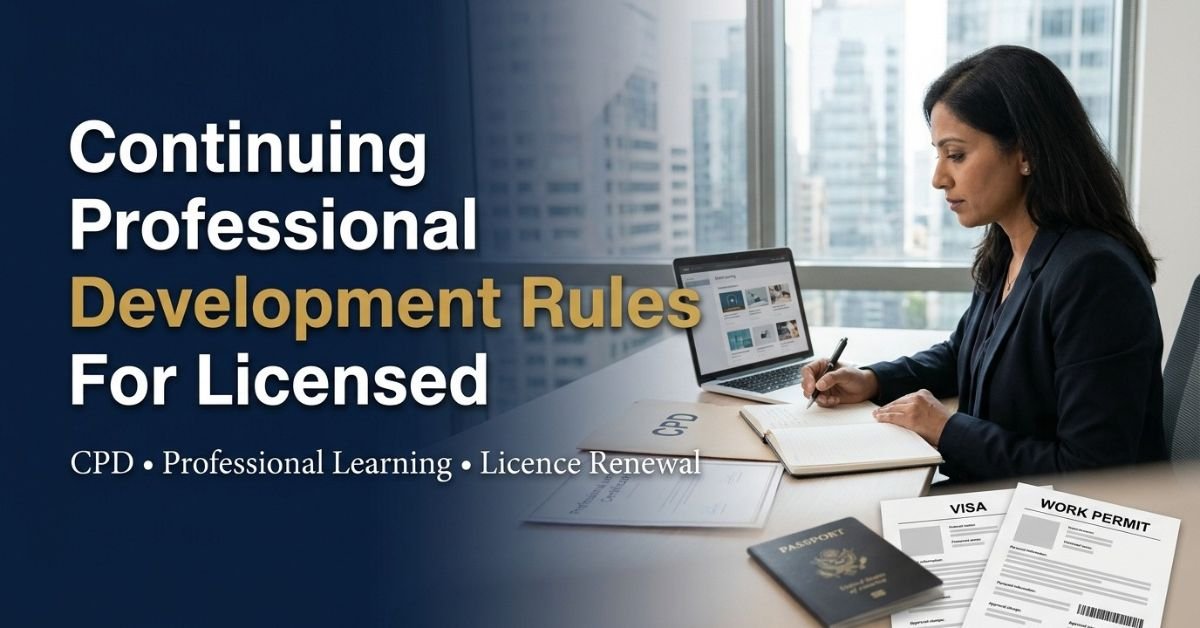
Continuing Proffesional Development Rules For Licensed Occupation
Many professionals approach CPD rules by asking one question: how many hours do I need? That question matters, but it does not tell the whole story. Learning can take time without addressing the skills a person needs, and a folder full of certificates can still leave important questions unanswered.
A stronger approach connects professional development to your responsibilities. What knowledge needs updating? Which tasks have become more demanding? What evidence shows that the learning took place, and how will you explain its relevance?
These questions matter whether you work close to home or build a career abroad. They also become useful when you change roles, take on supervisory duties, return from leave, or prepare to renew a professional registration.
This guide provides a general planning framework for readers worldwide. It does not assign universal hours, deadlines, exemptions, or approval rules, because those details depend on the profession and the body responsible for it.
Quick Answer
Continuing professional development is the ongoing learning professionals use to maintain and improve their capabilities. For a licensed occupation, the applicable requirements should guide activity selection, recordkeeping, and renewal preparation. A practical approach is to identify your obligations, choose relevant learning, preserve evidence, and review progress throughout the reporting period.
Your Learning Journey
Identify requirements → Assess learning needs → Choose suitable activities → Record evidence → Review progress → Prepare for renewal.
CPD Rules Begin With The Correct Registration
Before buying a course or calculating learning hours, establish which professional requirements you are trying to satisfy.
Start with your own registration details. Record the occupation, registration category, responsible body, and relevant reporting period. If your work involves more than one registration, prepare a separate summary for each.
This prevents you from building a learning plan around someone else’s circumstances. A colleague may have a similar job title while holding a different professional status or working under another set of requirements.
It also helps distinguish several overlapping interests. Your employer may want training for a particular workplace task. A professional association may encourage broader career development. Your licensing body may require evidence for continued registration.
One activity might serve several purposes, but you should check each purpose separately.
| Planning area | Question to answer | Useful record |
|---|---|---|
| Professional status | Which registration am I maintaining? | Registration details |
| Responsible body | Who determines the applicable requirements? | Name and contact information |
| Reporting period | Which dates does my learning record cover? | Start and end dates |
| Learning expectations | What must the learning demonstrate? | Personal requirements summary |
| Evidence | What proof should I retain? | Evidence checklist |
| Renewal preparation | What must I complete or submit? | Renewal task list |
Keep this summary short enough to use. A clear one-page reference is easier to review than a collection of scattered screenshots and messages.
If a requirement is unclear, write down the exact uncertainty. Precise questions are easier to resolve than a general concern that you might not have done enough.
Continuing Professional Development Requirements Need A Personal Plan
A useful learning plan starts with your work, not with a catalogue of available courses.
Think about responsibilities that require careful judgement, tasks you perform less confidently, and changes you expect in your role. Consider feedback you have received and situations where you needed more support than usual.
Turn these observations into specific learning objectives.
“Improve communication” is broad. “Explain technical findings clearly to clients without specialist knowledge” gives you a more practical target.
Similarly, “develop leadership skills” becomes more useful when connected to a real responsibility, such as giving constructive feedback to junior colleagues.
| Learning need | Practical objective | Possible learning approach |
|---|---|---|
| Difficulty explaining complex information | Produce clearer explanations for non-specialists | Communication workshop and feedback |
| New supervisory responsibilities | Give more useful guidance to colleagues | Mentoring and structured practice |
| Unfamiliar technical process | Understand the process and its limitations | Relevant training and supervised application |
| Inconsistent documentation | Make records clearer and more complete | Case review and targeted learning |
| Planned career move | Identify gaps before taking on new duties | Skills assessment and development plan |
These are planning examples, not a list of activities automatically accepted by every professional body.
The value of a personal plan is that it gives you a reason for each activity. You can explain what you hoped to learn and later assess whether it helped.
Leave room to adjust the plan. A new responsibility, unexpected challenge, or change in career direction may make a different learning priority more useful.
CPD Hours, Credits, And Learning Outcomes
Time spent learning, credits awarded, and learning outcomes describe different things.
Hours measure duration. Credits depend on the system awarding or recognising them. Outcomes describe what you understood, developed, or became better prepared to do.
Keep those distinctions clear in your records.
For an event, note the actual learning sessions you attended. Preserve the programme if it helps explain the duration or content. Avoid treating the advertised length of an event as sufficient evidence of your own participation.
If an activity awards credits, record them as stated. Do not invent a conversion into another system’s units.
Alongside the numerical record, add a short explanation of the learning.
For example:
- Purpose: Understand a process that has recently become part of my role.
- Activity: Complete relevant instruction and discuss practical questions.
- Learning: Identify the main stages, limitations, and points requiring additional support.
- Next step: Apply the learning within my responsibilities and seek feedback.
A meaningful outcome does not need to sound dramatic. You may have clarified a misunderstanding, recognised a limitation, or confirmed why an existing approach remains appropriate.
Honest, specific observations are more useful than claiming that every course produced a major professional breakthrough.
Accepted Learning Activities Require Careful Selection
The most convenient activity is not always the most suitable one.
Before enrolling, consider the subject, level, delivery method, practical relevance, and evidence available after completion. Then compare those features with your own requirements.
A beginner course may be valuable when you are entering a new area. The same course may add little if you already use the material confidently.
Equally, an advanced course may be difficult to apply if you lack the underlying knowledge. Select learning that stretches your understanding without skipping essential foundations.
| Activity | Potential benefit | What to examine |
|---|---|---|
| Structured course | Develops knowledge in a planned sequence | Level, content, assessment, and recognition |
| Workshop | Allows discussion and practical exercises | Participation and connection to your work |
| Professional reading | Supports focused investigation | Relevance and how you record the learning |
| Mentoring | Provides feedback and perspective | Objectives and evidence of development |
| Case discussion | Explores reasoning and alternative approaches | Learning purpose and confidentiality |
| Teaching preparation | Tests and deepens understanding | Whether the activity fits applicable criteria |
| Workplace project | Connects learning with a practical problem | The distinction between learning and routine work |
A useful screening question is: “What will I understand better after this activity?”
If the answer is unclear, examine the programme more closely before committing money or time.
Also consider variety. Different learning methods reveal different gaps. Reading may build background knowledge, while discussion can expose assumptions you did not realise you were making.
The right combination depends on your needs and applicable requirements.
Online Learning And Overseas Training
Online learning can be convenient for professionals balancing work, family responsibilities, and limited access to nearby training.
However, the delivery method alone does not establish quality or suitability. A recorded presentation, an interactive workshop, and a supervised practical session provide different experiences.
Check what participation involves. Will you complete an assessment? Can you ask questions? Does the provider supply evidence of completion? Is the material appropriate for your level?
For overseas training, consider both the learning value and its relevance to your professional setting.
Some knowledge transfers readily between workplaces. Other material may depend on local procedures, terminology, equipment, or professional expectations.
Before paying for a course intended to satisfy a specific requirement, clarify any uncertainty about recognition. Provide enough detail for a meaningful answer, including the syllabus, format, provider, and expected evidence.
If you already completed training abroad, organise the records before seeking recognition. A clear course description and completion record are more helpful than a certificate with an unfamiliar title and no supporting explanation.
For professionals holding multiple registrations, assess the activity separately against each set of requirements. Keep any recognition decisions with the relevant records.
A CPD Portfolio Should Tell A Clear Learning Story
A portfolio should make it easy to understand what you did, why you did it, and what you gained.
It does not need decorative formatting or unnecessarily long reflections. Consistency matters more.
Use a simple entry for each activity, with supporting documents stored where you can find them.
| Portfolio field | What to record | Purpose |
|---|---|---|
| Activity | Title, provider, and format | Identifies the learning |
| Date | Completion or participation date | Places it in the reporting period |
| Duration or credits | Accurate amount, where relevant | Supports numerical tracking |
| Learning objective | The need you intended to address | Explains your choice |
| Main learning | Specific knowledge or understanding gained | Captures the substance |
| Application | Intended use or further development | Connects learning to work |
| Evidence | Certificate, notes, or other suitable record | Supports the entry |
Write your learning note while the activity is still fresh.
A short reflection might explain that you previously misunderstood a process, describe what became clearer, and identify a question you still need to resolve.
Avoid filling every entry with the same sentence. Repeated statements such as “This improved my professional skills” say very little about the actual learning.
Keep confidential information out of general portfolio descriptions. Explain the professional issue without including unnecessary personal, client, patient, or commercially sensitive details.
Suggested Image Placement: An organised learning portfolio beside a laptop and notebook.
Caption: Clear records connect each activity with a learning purpose and a practical next step.
Professional Licence Renewal Deserves Its Own Checklist
Learning and renewal administration should have separate checklists.
Your learning plan tracks development activities. Your renewal checklist tracks the actions needed to complete the relevant process.
Combining them into one vague reminder can make it easier to overlook an unfinished declaration, missing document, or unanswered request.
Prepare your renewal checklist early. Include the relevant dates, required information, supporting records, and any status checks you need to make.
Use a personal review date before the actual deadline. This gives you time to locate evidence, resolve unclear entries, and address genuine gaps.
When reviewing your portfolio, check more than the total hours or credits. Look at activity dates, required categories, and whether the evidence supports the claims you intend to make.
After completing the process, retain the acknowledgement and confirm the resulting status through the appropriate channel.
Do not rely solely on memory. A saved confirmation and a dated record of your final check make later questions easier to answer.
Employer Training, Funding, And Access To Records
Employer-supported learning can be valuable when it connects directly with your responsibilities.
To request support, explain the need clearly. Describe the skill you want to develop, how the activity relates to your role, and what practical benefit you expect.
Include time as well as cost. A course may be affordable but difficult to complete without protected learning time or an adjusted schedule.
Before agreeing to employer-funded training, understand the arrangements. Clarify payment, attendance expectations, record access, and any terms attached to the support.
Your personal development plan should also remain usable when you change jobs.
Keep permitted copies of your own completion records and learning notes. Do not assume that access to a workplace training platform will continue after your employment ends.
At the same time, respect the distinction between personal evidence and confidential organisational material. A training confirmation may be appropriate to retain, while internal case documents may not be.
Discuss uncertainty before copying records. Good organisation should not create a separate information-handling problem.
Career Breaks And Changes In Working Hours
A change in working pattern is a good time to review your learning plan.
Reduced hours, extended leave, a move into management, or a temporary pause in professional practice can change what learning is practical and relevant.
Start by checking how your professional status and applicable requirements relate to the change. Avoid calculating your own reduction or assuming that a break automatically removes an obligation.
From a planning perspective, consider what you want to maintain during the break and what you may need before returning.
A return-to-work learning plan might focus on refreshing unfamiliar processes, understanding developments in the workplace, and identifying where supervision would be useful.
Keep the plan realistic. A small number of well-chosen activities can be more manageable than an ambitious schedule that ignores your circumstances.
If you receive an official adjustment or other decision, retain the details. Note exactly what it covers and any conditions attached.
An accurate record helps prevent confusion when you later review the period or prepare for renewal.
A CPD Audit Should Be Supported By Understandable Evidence
The best preparation for a possible review is a portfolio that remains clear throughout the year.
You should be able to explain each entry without reconstructing the entire event from memory.
Check that the evidence supports the type of claim being made. An attendance record shows something different from an assessment result. A course programme describes planned content, while your own notes help explain what you learned.
If asked to provide information, follow the actual request. Organise the response around the required questions rather than sending a large collection of unrelated documents.
Where an entry is unclear, improve the explanation using genuine records. Do not strengthen it by adding experiences or outcomes that did not happen.
If evidence is missing, explore whether a provider can supply a replacement or confirmation. Record any remaining uncertainty honestly.
The objective is a truthful, coherent account of professional development. A modest activity with clear evidence is easier to explain than an impressive claim supported by very little.
Missing Requirements Need A Specific Recovery Plan
When you identify a gap, define it carefully before trying to fix it.
You may be missing learning in a particular area, proof of an activity, an accurate calculation, or an administrative step. These problems require different responses.
Start with a short gap list:
- What appears incomplete?
- What records are available?
- Which requirement does the issue relate to?
- What clarification is needed?
- What action can you take now?
Do not assume that completing an additional course resolves every type of shortfall. It may improve your knowledge without correcting an earlier reporting or submission issue.
Seek clarification from the responsible body where necessary, and preserve the response.
If your authority to carry out particular work is uncertain, resolve that question directly rather than relying on assumptions.
For professionals working abroad, track immigration and employment permissions separately from professional development. Each has its own purpose, and a learning certificate should not be treated as proof that every other work-related requirement has been satisfied.
Key Takeaways
- Build your plan around your own professional registration and responsibilities.
- Choose activities for a clear learning purpose.
- Keep hours, credits, and outcomes distinct.
- Check uncertain recognition before paying for training.
- Record learning and evidence promptly.
- Review renewal administration separately from course completion.
- Address gaps honestly and seek specific clarification when needed.
Frequently Asked Questions
Can Free Learning Be Useful For Professional Development?
Yes. Learning value does not depend entirely on price. A focused discussion, carefully selected reading, or a useful educational session can support development. Whether an activity counts towards a particular requirement depends on the applicable criteria and available evidence.
Should I Choose Several Short Courses Or One Longer Programme?
Choose according to your learning needs. Short activities can address specific questions, while a longer programme may provide a stronger foundation in an unfamiliar area. Consider depth, relevance, scheduling, and recognition rather than course length alone.
What If A Course Repeats Material I Already Know?
Record the outcome honestly. The activity may have confirmed your understanding or revealed only a small new insight. Use that experience to choose a more suitable level next time instead of exaggerating what you gained.
Can I Use The Same Portfolio For Multiple Registrations?
A shared storage system can be practical, but maintain a separate requirements summary for each registration. Label activities clearly and assess their suitability independently. One organised collection of documents does not mean every activity satisfies every framework.
How Often Should I Update My Learning Records?
A practical habit is to update them shortly after each activity and review the whole record periodically. This reduces reliance on memory and helps you identify gaps while there is still time to respond.