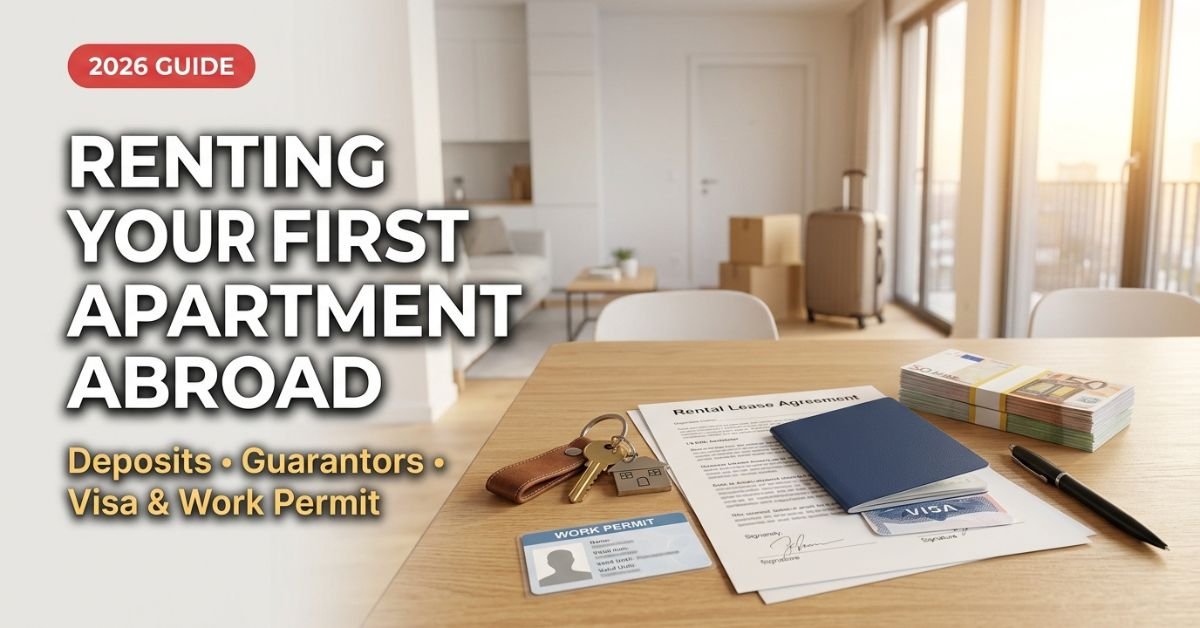
Renting Your First Apartment Abroad: Deposits, Guarantors And Contracts
Renting your first apartment abroad comes down to three things: how much the landlord can hold as a deposit, who stands behind you if the rent goes unpaid, and what kind of contract you actually sign. Get those three right and most of the stress disappears. Get them wrong and you can lose months of savings before you’ve unpacked a single box.
The trouble is that newcomers arrive carrying assumptions from home. Some of those assumptions are harmless. Others are expensive.
Quick Answer
In many countries, landlords can’t set any deposit they like. Rules often limit the amount, control where the money is held, and set a deadline for returning it. If you lack a local guarantor, professional guarantor services, employer letters or bank guarantees can fill the gap. Always confirm the contract type before paying anything.
Key Takeaways
- Deposits are often limited by law or custom, and the limit is usually tied to base rent rather than rent plus bills.
- Paying many months upfront can win you a flat, but that money usually has far less protection than a deposit.
- A local guarantor is rarely the only option. Paid guarantor services and employer support are common alternatives.
- The type of contract you sign decides your notice period, your security and sometimes your deposit.
- Never pay for a property you haven’t seen, either in person or on a live video walk-through.
A Deposit Is Whatever The Landlord Decides
Fact: In a large number of countries, the amount a landlord can take is limited — and the limit is often lower than first-time renters expect.
Many places set a ceiling on residential deposits, commonly somewhere between a few weeks’ and a few months’ rent. Where no formal cap exists, local custom usually settles into a predictable range, and anything well above it deserves a direct question.
What catches people out is the calculation. In many markets, the cap is based on the base rent alone, not the total you pay once heating, water, building charges or internet are added. A landlord who quietly calculates the deposit on the higher “all-in” figure can end up asking for far more than the rules allow.
Some housing markets also use arrangements that look nothing like a standard deposit. In certain parts of East Asia, tenants may pay a non-refundable “thank-you” fee to the landlord on top of a deposit, while other systems rely on a very large lump sum that is returned in full at the end of the lease instead of monthly rent. Neither is a scam. They are simply different systems, and you need to know which one you’re in before comparing prices.
Three questions to ask about any deposit, anywhere:
- What rent figure is this calculated on?
- Where will the money be held while I live here?
- When, and on what conditions, will it come back?
Offering Months Of Rent Upfront Is The Best Way To Win A Flat
Fact: It can work, but it shifts a lot of risk onto you — and some places restrict it.
In competitive cities, newcomers often think a big upfront payment will push them to the front of the queue. Sometimes it does. Landlords like certainty, and someone without a local credit record or payslips can look like a gamble.
In several markets, paying a year’s rent in advance, or handing over a set of dated cheques for the full year, is simply the norm rather than a bargaining tactic. Elsewhere, the law actively limits how much rent a landlord can demand before the tenancy begins.
Here’s the part that rarely gets said plainly. Prepaid rent is usually treated very differently from a deposit. A deposit may sit in a protected account with rules about its return. Rent paid in advance often has no such protection. If the flat is not as described, or the landlord runs into financial trouble, recovering that money can be slow and uncertain.
If you do pay ahead, keep it proportionate, get a receipt that states exactly which months it covers, and make sure the contract spells out what happens to that money if the tenancy ends early.
You Need A Relative Living In The Country To Be Your Guarantor
Fact: Guarantor alternatives exist in most major rental markets, precisely because so many tenants arrive without one.
A guarantor is someone who agrees to pay if you don’t. Landlords in many countries want that person to live locally and earn a solid income there, which rules out parents and relatives back home. For students, graduates and people on their first overseas job, this is often the single biggest obstacle.
The good news is that you have options:
- Professional guarantor services. Private companies act as your guarantor in exchange for a fee, often a percentage of the annual rent or a monthly charge.
- University schemes. Many universities guarantee rent for their international students, either directly or through a partner.
- Employer support. A letter from your new employer confirming your role, salary and start date carries real weight. Some relocation packages go further and guarantee the lease or pay the deposit.
- Bank guarantees and rent guarantee insurance. A bank can block a sum in your account and issue a guarantee to the landlord. Insurance products can replace a cash deposit in exchange for a yearly premium.
- Public guarantee programmes. Some governments run free or low-cost guarantee schemes for young people, students or recently hired workers.
A Deposit And A Guarantor Do The Same Job
Fact: They protect the landlord against different things, which is why some landlords ask for both.
Think of it this way. The guarantor is there for the middle of the tenancy — if you lose your job and the rent stops, someone else pays. The deposit is there for the end — damage beyond normal wear, unpaid utility bills, a missing key, the cleaning the flat needed when you left.
Because they cover different risks, one rarely replaces the other completely. A free guarantee scheme might cover unpaid rent but not provide the deposit itself. A bank guarantee might satisfy the deposit requirement while the landlord still wants a person or company to guarantee rent.
Some places also limit how many layers of security a landlord can stack on top of each other. If you’re being asked for a deposit, a guarantor, insurance and several months upfront, it’s reasonable to ask which rule allows all of that at once.
A Rental Contract For Your First Apartment Abroad Works The Same Everywhere
Fact: Contract types vary enormously, and the type you sign determines most of your rights.
Broadly, you’ll meet four families of contract around the world:
- Open-ended leases. Common in parts of Europe. They run until someone gives notice, and tenants often enjoy strong protection against eviction.
- Fixed-term leases. Popular in many English-speaking countries and much of Asia. You’re committed for a set period, typically six to twelve months, and leaving early can cost you.
- Periodic or rolling agreements. These renew automatically month by month or year by year until ended with proper notice.
- Short-term, seasonal or furnished-let contracts. Designed for temporary stays. They’re convenient, but they frequently come with weaker protection and larger deposits.
The warning sign is a mismatch. If you’re moving permanently for a job but the landlord offers a “holiday” or “temporary” contract for a flat you’ll live in all year, ask why. That label can quietly remove protections you would otherwise have.
Also check whether the contract must be registered with a local authority, whether it renews automatically, and how much notice each side must give. These details matter far more in month eleven than they seem to in week one.
You Can Sign A Contract In A Language You Can’t Read And Sort It Out Later
Fact: You’re bound by what the document says, in the language it’s written in, from the moment you sign.
Plenty of newcomers sign because the agent “explained it” or because everyone else seems to. Then a surprise clause appears months later, and there’s little room to argue.
You don’t need a lawyer for every lease, but you do need to understand the parts that affect your money and your freedom. Use a translation tool for a first pass, then ask a colleague, your HR team or a local friend to check the sections that matter most:
- What the rent covers. Base rent only, or rent plus service charges, heating and other costs?
- The deposit. The exact amount and how it was calculated.
- Notice periods. For you and for the landlord.
- Rent increases. How often, by how much, and whether they’re tied to inflation.
- Condition report. Whether a detailed inventory will be done at move-in, with photos.
- Alterations. Whether you can paint, drill or mount anything on the walls.
- Sub-letting and guests. Some contracts restrict long-stay visitors more strictly than you’d expect.
If The Photos And Contract Look Professional, The Listing Is Real
Fact: Polished photos and a convincing contract are the easiest things for a fraudster to copy.
People looking for a first apartment abroad are an ideal target. They’re searching from a distance, they’re under time pressure, and they don’t know what a fair price looks like in a new city. A well-made fake listing uses real photos lifted from a genuine advert, a believable backstory about why the owner can’t meet you, and a deposit request that arrives just as you’re starting to relax.
Even seeing the property isn’t complete proof. Someone can gain access to a vacant flat, or pose as the current tenant, and still have no right to rent it out.
A few rules hold up in almost every country:
- Don’t send money before a proper viewing — in person, or a live video walk-through where the person moves through the actual flat in real time.
- Confirm who owns or manages the property through an independent channel, not just the contact details in the advert.
- Be wary of prices well below similar homes nearby, especially when paired with pressure to decide today.
- Avoid payment methods that can’t be traced or reversed.
- Book a short-term stay for your first few weeks and sign your long-term lease once you’re on the ground.
You Get Your Deposit Back Whenever The Landlord Gets Around To It
Fact: Many places set deadlines for returning deposits, and some penalise landlords who miss them.
Return rules usually follow a similar pattern. If the flat is handed back in good order, the deposit should come back fairly quickly. If the landlord wants to deduct something, they’re often expected to explain and justify each deduction, and they may get a little more time to do so. In some systems, late repayment adds interest or a penalty in the tenant’s favour.
The difference between “normal wear and tear” and “damage” is where most disputes happen. Faded paint, minor scuffs and carpets that show a few years of use are generally part of ordinary living. Broken fittings, burn marks and large stains usually aren’t.
Your strongest protection is created on the day you move in:
- Walk through every room and take timestamped photos and video.
- Record meter readings.
- Note every existing mark on the condition report, however small.
- Keep copies of the contract, receipts and all messages with the landlord.
Do the same on the day you leave. If there’s a disagreement later, the person with better evidence usually wins.
Myth vs Fact
| Myth | Fact |
|---|---|
| The landlord sets any deposit they like | Many countries limit deposits, often based on base rent only |
| Paying months upfront is always smart | Prepaid rent often has less protection than a deposit |
| You need a local relative as guarantor | Guarantor services, universities, employers and banks can step in |
| A deposit and a guarantor are the same | A guarantor covers unpaid rent; a deposit covers what’s owed at move-out |
| Contracts work the same everywhere | Contract type decides notice, security and sometimes the deposit |
| Sign now, translate later | You’re bound by the text in its original language |
| A professional listing must be real | Photos, contracts and even viewings can be faked |
| Deposits come back at the landlord’s pace | Many places set return deadlines and require justified deductions |
Bottom Line
Your first apartment abroad is usually protected by more rules than you expect, but only if you understand the deposit, the guarantor arrangement and the contract type before you pay. Sort your guarantor route early, refuse to send money for a flat you haven’t properly seen, and document the property’s condition on your first and last day. Rental rules differ from country to country and change over time, so confirm the local requirements with an official authority or a tenant advice organisation before you sign.
FAQ
How Much Money Should I Budget To Move Into A Rented Flat Abroad?
Plan for the deposit, the first month’s rent, any agency or registration fees that apply locally, and a buffer for connecting utilities and buying basic furniture. In markets where rent is paid annually or deposits are large, your move-in cost can be several times the monthly rent, so check the local norm early.
Can I Rent An Apartment Abroad Before I Arrive?
You can, but it carries more risk. Many experienced movers book a short-term furnished place for the first few weeks, then view and sign their long-term flat in person.
What Documents Do Landlords Usually Ask Foreign Applicants For?
Typically a passport, a visa or residence permit, an employment contract or proof of enrolment, recent payslips or bank statements, and sometimes a reference from a previous landlord or a guarantor approval letter.
Is Rent Guarantee Insurance Better Than Paying A Cash Deposit?
It depends on how long you’ll stay. Insurance or guarantee products charge a fee you don’t get back, so they often suit short stays. For longer tenancies, a cash deposit that’s returned at the end can work out cheaper.
What Should I Do If My Landlord Refuses To Return My Deposit?
Ask in writing for an itemised explanation of any deductions and a date for repayment. If that fails, contact your local tenant advice service or dispute resolution body, and keep your move-in and move-out photos ready as evidence.